There is a simple test for any piece of wildfire fighting equipment. Does it hold together at hour twelve of a shift, on a 40-degree slope, after the wind has shifted and the fire is no longer where anyone expected it? That is the actual use case. Not a product demonstration. Not a trade show floor. The real thing, under real conditions, when a crew member is already running on fatigue.
Most firefighting gear suppliers do not build to that standard. They build to a price point, source from wherever the margin works, and assume the fire line will sort itself out. That assumption has a body count behind it.
What Fires Actually Demand from Your Gear
Fires are not getting easier. Climate intensification has lengthened seasons, deepened drought cycles, and pushed fire into fuel conditions that were historically far less combustible. A fire that would have been a contained two-day event a generation ago now runs crews for weeks across terrain that has no margin for equipment that is merely adequate.
Hand tools sit at the end of that chain. Everything from the air tanker overhead to the engine on the road exists, ultimately, to support what a crew member does at ground level with the tool in their hands. When that tool fails at the head-to-handle joint, or cannot be swapped fast enough when fuel conditions change mid-task, the whole system behind it loses effectiveness.
We built Dragonslayers equipment around that operational reality rather than around what is easiest to manufacture or cheapest to source.
Three Things Standard Gear Gets Wrong
| 1. Single-function design. A tool that only digs forces a crew member to stop, walk back, and swap implements every time conditions change. On a fast-moving fire line, that is time nobody has. 2. Weak head attachment. Most conventional handles rely on a wedge or friction fit at the head joint. Under repeated heavy impact, that connection loosens. A head separating from a handle mid-swing is not a warranty issue. It is a safety event. 3. Replacement over repair. When a blade wears down, most tools on the market go in the trash. That model costs departments significantly more over a five-year equipment program than a tool with replaceable components and a handle built to outlast multiple blades. |
How We Addressed Each One
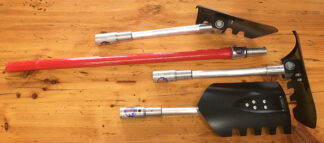
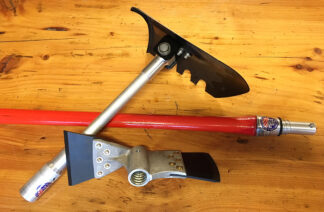
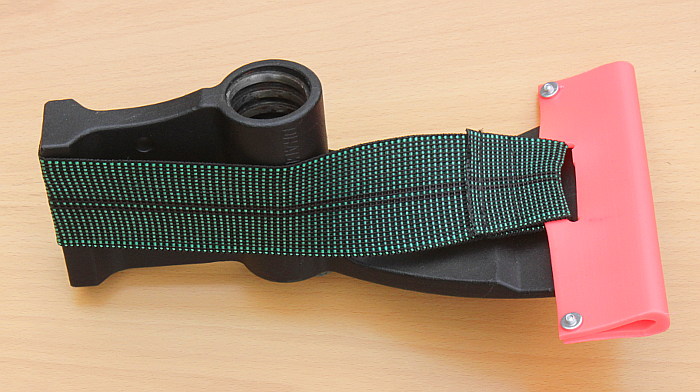
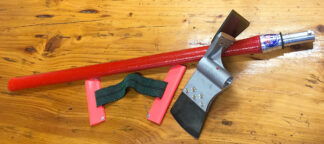
Our Troop Tool carries three interchangeable blade sets, including a McLeod-style scraper, a high-back fire rake blade, and an angled shovel configuration. One tool head, three distinct functions, swapped in the field in seconds. The same fire fighter scrapes line, rakes duff, and throws dirt without putting anything down.
The Universal Handle, 37 inches of American hickory with a spring-loaded locking pin, eliminates the head separation problem entirely. The pin snap-locks every tool head we make. Under any field load, at any angle, the head stays exactly where it belongs.
On blade replacement: Hot Shot crews have run nine full blade changes on a single Magnum Pulaski head. The hickory handle underneath those nine blades has never needed replacement. That is the real cost model, and it is a very different number than the sticker price on a cheaper tool suggests.
What to Ask Before You Buy
Whether you are outfitting a crew for the first time or re-evaluating a department’s procurement cycle, these four questions separate serious wildfire fighting equipment from the catalog filler most suppliers lead with.
| Question | What the Answer Reveals |
| Was it designed for wildfire specifically, or adapted from general use? | Purpose-built tools reflect how fire actually behaves; adapted tools cut corners on the parts that matter most |
| Can it be repaired when components wear, or does it require full replacement? | Repairability determines true five-year program cost, not the unit price on the purchase order |
| What happens to the head attachment under repeated hard impact? | Friction fits and basic wedges loosen; a spring-loaded locking pin does not |
| Who tested it, and under what conditions? | Lab testing and fire line testing produce very different tools; one gets used when the stakes are real |
For Rookies, Veterans, and the People Who Sign the Purchase Orders
If you are new to this work, the gear you start with shapes the habits you build. Start with equipment designed for the job.
If you have twenty years on the line, you already know exactly what a poorly designed tool costs you at the end of a hard shift. You have felt it in your shoulders and your hands. We built Dragonslayers tools because we felt it too.
And if you are the one signing the purchase order: the firefighting gear suppliers offering the lowest unit price are not running the full cost calculation. We are. That math is worth a conversation before the next procurement cycle closes.
Frequently Asked Questions
Yes, and the results are documented. In a live training exercise with 40 Spanish fire fighters, the first test structure burned to the ground in minutes under 20 mph wind and dry straw fuel with no control lines in place. After one hour of instruction using the right tools and technique, all 40 structures survived identical conditions. No exceptions.
The Universal Wildfire Mitigation Blueprint was tested across four National Wildlife Refuges in Alaska, covering territory as large as the state of New Jersey. BLM and USFS Smokejumpers parachuted in to establish control lines around 17 different U.S. Government structures, alongside local Athabaskan villagers. These were real structures under active fire threat, not simulated environments.
The Universal Handle is built to last an entire career. Replaceable blades mean worn components are swapped independently rather than scrapping the whole tool. Hot Shot crews have logged nine complete blade changes on a single Magnum Pulaski head, with the hickory handle still performing throughout. That durability changes the real cost calculation significantly.
Dragonslayers was awarded USDA Small Business Innovation Research grants to develop better wildfire hand tools for all five federal wildfire agencies. Tools from that program are now in active use by the Entiat IHC in Washington and the Prineville IHC in Oregon. Federal research funding and ongoing IHC adoption are independent of any claim we make ourselves.
Yes. Because every Dragonslayers tool head shares the same Universal Handle mechanics, a crew member trained on one tool already understands every other tool in the lineup. In the Spanish training exercise, participants with zero prior fire fighting experience were applying the technique confidently after a single afternoon of instruction.