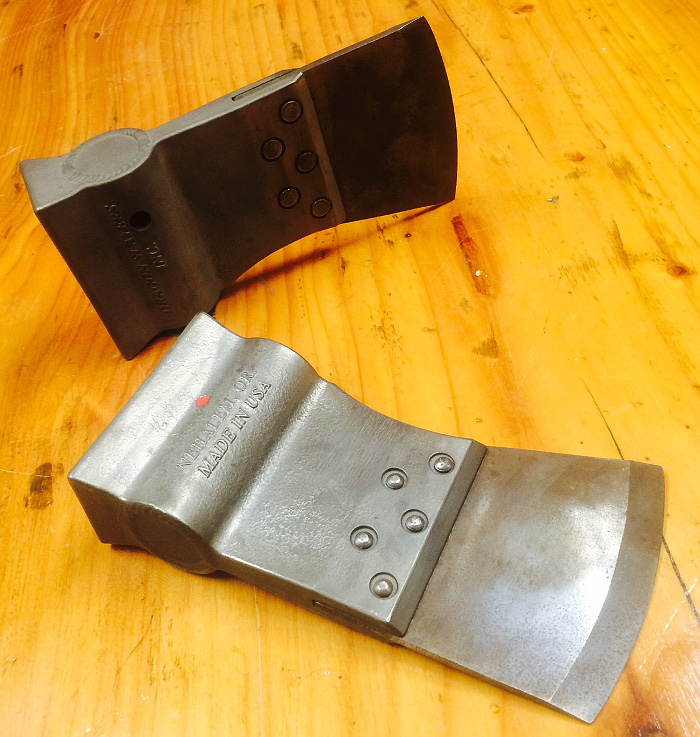
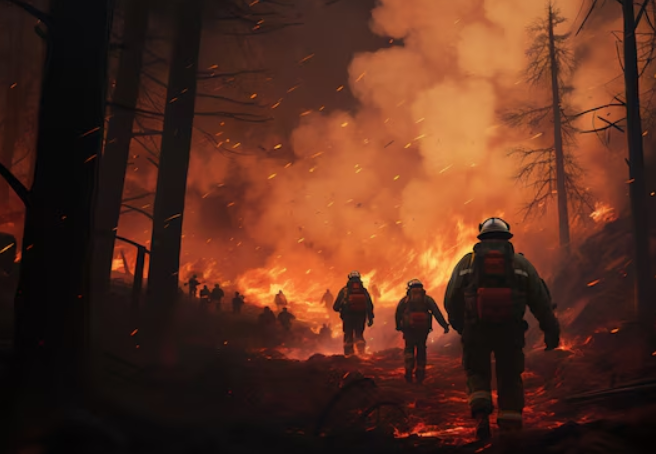
In 1947, a Smokejumper named Wagner Dodge did something nobody had trained him to do. He lit a fire in front of himself, climbed into the ashes, and lived. Thirteen of his crew, running from the same flames, did not. That single decision became the seed of what we now call Escape Fire Control, and it still shapes how Dragonslayers thinks about wildfire survival today.
This is not a history lesson for its own sake. The Mann Gulch fire and the man who survived it hold a lesson that almost nobody outside of fire science ever hears about, and that lesson is more relevant now than it was in 1947.
Death in the Short Grasses
Sixteen jumpers parachuted into a quiet fire outside Helena, Montana. The fire sat low in a timbered draw, the kind of fire a crew handles without much drama. They checked their gear, picked up tools, food, and water, and started down toward the smoke.
Then the wind turned. A gust came out of nowhere and pushed the fire out of the timber and straight up the open, grass-covered slope the crew was standing on. Slope and wind together meant the fire was no longer behind them. It was coming for them.
Dodge tried to call the crew back to him. Between the wind, the roar of the flames, and tools clanking against gear, most never heard him. He struck a match and lit the grass in front of his own feet, then walked into the ashes and lay down with his feet toward the fire. The patch he created was roughly 75 feet by 100 feet of burned ground; what fire crews now call the black.
He was buffeted by heat and wind but never burned. Two other jumpers scrambled over rimrock to a rockslide and survived on bare stone. Thirteen others did not make it. When asked later if he had ever trained for what he did, Dodge gave a simple answer. It just seemed like the logical thing to do.
Why Nobody Taught This for Decades
An escape fire has no leash on it. Once you light it, you cannot fully control where it spreads or how fast. For exactly that reason, fire agencies have been reluctant to teach it as a standard technique. It works when there is no better option left, but it carries real risk of its own.
That reluctance left a gap. Dodge proved an escape fire could save a life when every other option was gone, but nobody built a system around making that choice safer, more predictable, or available before the moment of crisis. Escape Fire Control is our answer to that gap.
Sun Tzu Saw This Coming, 2,000 Years Early
Long before wildfire science existed, a military strategist named Sun Tzu wrote a chapter in The Art of War called Attack by Fire. Military academies still teach it. Most readers skim past the final lines, the ones warning that knowing how to attack with fire means nothing if you do not also know how to defend against being attacked by it.
Sun Tzu never wrote the defense himself. We built it. Take his idea of a 360-degree defensive position, the kind used to shape a battlefield against attack from any direction, and combine it with what Dodge proved in the short grasses of Mann Gulch. The result is a way to create controlled black space around a home, a crew, or a town, before the fire storm ever arrives, instead of improvising one in a moment of panic.
Shaping the Battle Space Before the Fire Arrives
Here is the difference between what Dodge did and what Escape Fire Control does. Dodge had seconds. He lit one fire, once, with no plan and no second chance. Escape Fire Control gives you the plan ahead of time, built and practiced long before a fire storm shows up on the ridge.
Three concentric control lines circle whatever you want to protect: a home, a cluster of homes, a town. The space between those lines gets thinned, pruned, and cleared of light fuel ahead of fire season. When conditions turn dangerous, a trained operator lights a controlled strip of fire just inside the outer lines, using the wind instead of fighting it.
The flame runs a short distance, hits the control line, and goes out. No fuel left to burn means no fire left to spread. Repeat that around the full circle and you get exactly what Dodge created by accident: a ring of black, except this one is planned, practiced, and does not depend on a single man’s instinct under pressure.
The Two Instincts Every Fire Fighter Already Knows
Long before Escape Fire Control had a name, wildland fire crews lived by two basic instincts. Both point toward the same idea Dodge acted on at Mann Gulch.
| 1. Black-line is the only complete fireline. Burned ground has no fuel left to carry flame, so a fire cannot cross it. This is the entire logic behind a control line. 2. Get into the black. If a fire hooks around unexpectedly, or a spot fire ignites somewhere nobody saw coming, the only real option left is to reach ground that has already burned. |
Dodge did not invent these instincts. He simply ran out of time to dig a line the normal way, so he created his own black space on the spot, then got into it. Escape Fire Control takes that same instinct and gives it structure, training, and enough lead time that nobody has to improvise it under fire.
What This Looks Like in the Field
We tested this method across four National Wildlife Refuges in Alaska, working with Smokejumpers and local Athabaskan crews from villages inside the Koyukuk, Innoko, Selawik, Nowitna, and Kanuti refuges. Crews referred to the test sites as the Black Donut projects, since the finished pattern of control lines, burned ground, and protected center looks exactly like its name.
Later, the same method was tested with Spanish fire fighters in a live outdoor training exercise. Forty students, each with their own small training house, faced 20 mile-per-hour winds and dry straw fuel. The first house, lit without any control lines in place, burned to the ground in minutes with flame lengths reaching six feet.
After an hour of classroom instruction on the method, the same forty students went back outside, faced identical wind and fuel conditions, and applied the technique themselves. None of the forty houses burned. People with zero fire fighting background learned to control flame length and protect a structure in a single afternoon.
| Test Round | Control Lines Used | Outcome |
| Before training | None | House destroyed; flame lengths reached 6 feet |
| After training | Three concentric control lines | All 40 houses survived; flame length fully controlled |
The Strategic Takeaway
Wagner Dodge proved, by accident and under extreme pressure, that a controlled escape fire could outwit a fire storm too strong and fast to fight head-on. What he lacked was time, training, and a plan. Most people facing a wildfire today are in the exact same position he was: out of options, with seconds to decide.
Escape Fire Control closes that gap before the emergency starts. It takes Dodge’s instinct, Sun Tzu’s defensive logic, and decades of field testing, and turns them into something a trained home owner or fire crew can set up and practice long before the wind shifts and the fire turns toward them. The goal has never changed since Mann Gulch in 1947: get into the black, survive, and let the fire pass with nothing left to burn.