Bonnie Hammer Tool Kit

Bonnie Hammer Tool Kit

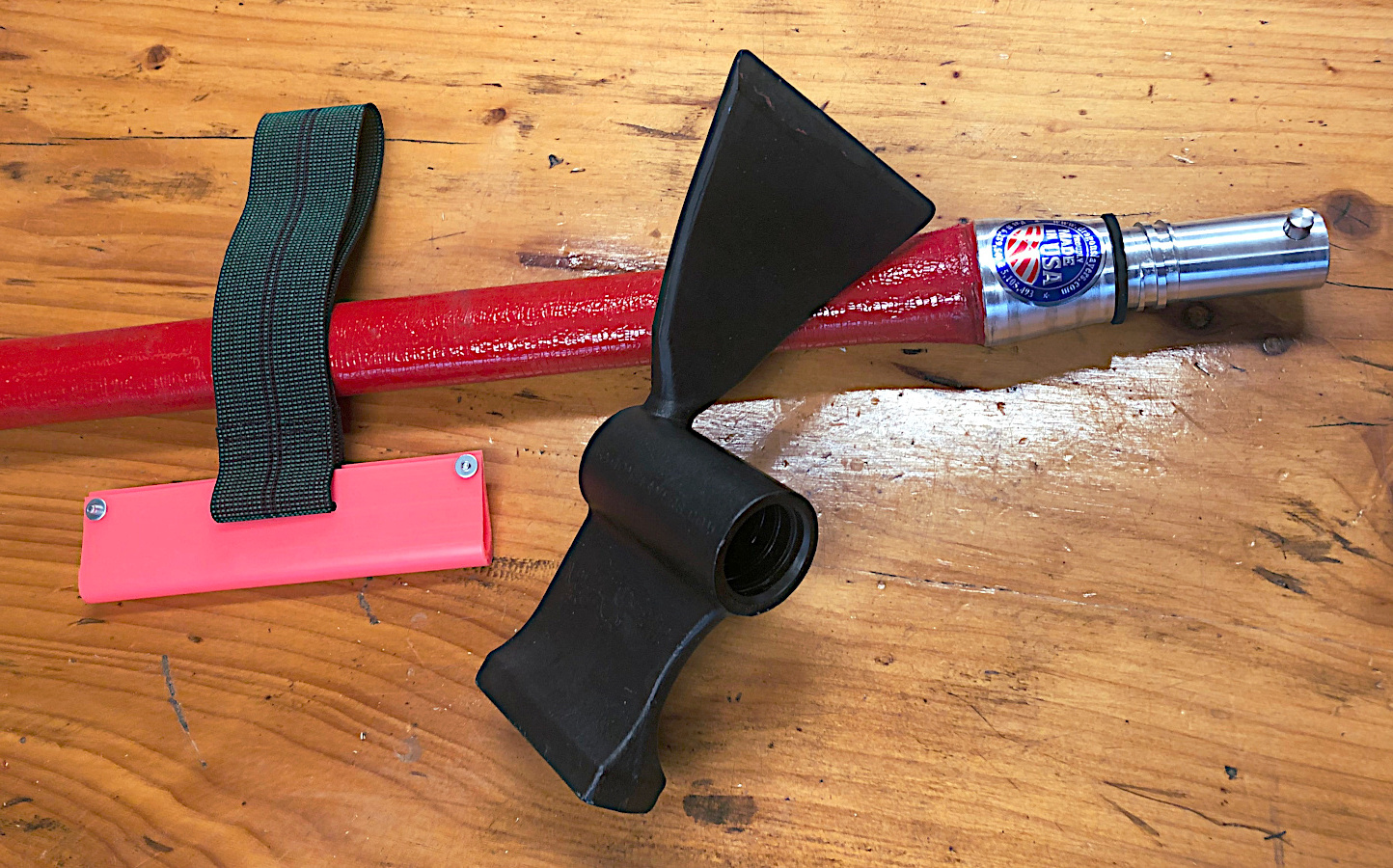
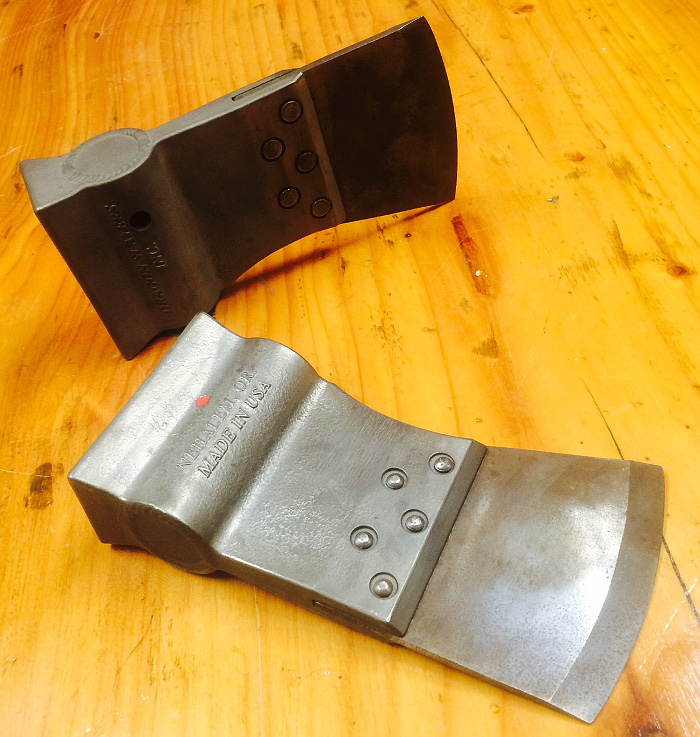
Bonnie Hammer Head. 3.3 lbs Tool is used to drive tree-felling wedges by chainsaw crews and for “grubbing” fire line when needed. Specifications:   9 1/2″L  x 4 1/2″W x 3 1/2″H; Grub blade 4 1/2″; hammer head 3″L x 1 1/4″W Total length 37 1/2″L when attached to Universal Handle.

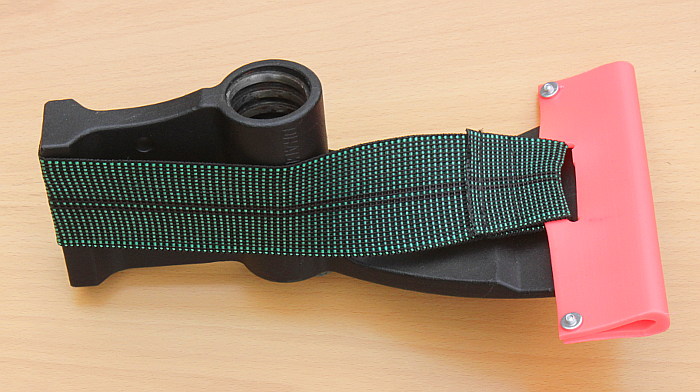
Blade Guard. 4.4 oz. Blade guard is constructed of a durable plastic sheath and elastic webbing.

Universal Handle. 2.1 lb. Hickory, 37 ins. long. This specially engineered wooden handle with snap-lock fitting, is longer and approximately twice the strength of a traditional Pulaski handle. The hardened-aluminum CNC-manufactured male fitting locks into all Dragonslayers™ tool heads.

Important Maintenance Tip: Because the Bonnie Hammer tool head is high-carbon forged steel, it is of vital importance to detach the tool head from the handle immediately after use in the field, and that the tool head threads be greased, preferably with a lithium-based grease to avoid corrosion.

Bonnie Hammer

new bonnie slam

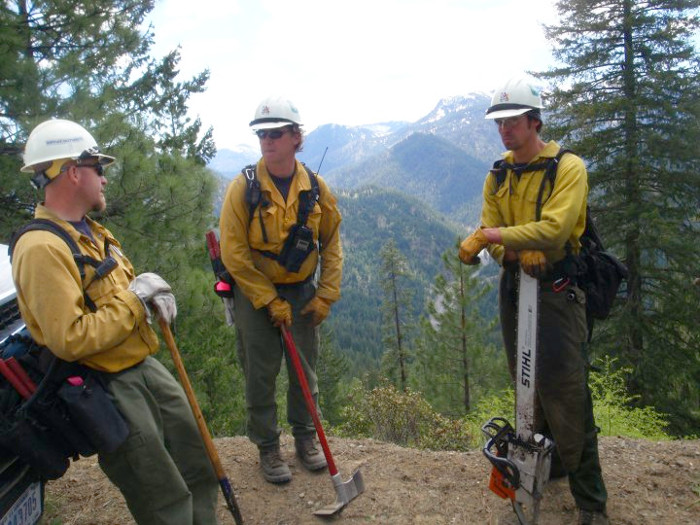
The Bonnie Hammer tool head is made for tree fellers or chainsaw crew assistants. A majority of the Hotshot Crews carry four chainsaws with their 20 person crews. This tool originated from a request to us by the Bonneville Hotshot Crew to design and manufacture a combination tool to drive felling wedges and to grub fire line. The first-generation Slam Hammer tool head was cast steel, while this current-generation is forged steel for greater strength and durability.   The Bonnie Hammer tool head attaches to our Universal Handle (sold separately). The tool head has a steel flat head on one side, and a 4 1/2-inch wide  grub-hoe blade on the other.  This tool head is now our second-most popular tool.

Important Maintenance Tip: Because the Bonnie Hammer tool head is high-carbon forged steel, it is of vital importance that the tool head be detached from the handle immediately after use in the field, and that the tool head threads be greased, preferably with a lithium-based grease to avoid corrosion.

Going to buy a Universal Handle separately with a Bonnie Hammer? Consider saving money by purchasing the Bonnie Hammer Toolkit.

Posted on

What Serious Wildfire Responders Actually Need from Their Firefighting Gear Suppliers

Wildfire-Responders

By Thomas “Troop” Emonds, Founder  ·  Nehalem, Oregon  ·  23 Years U.S. Forest Service & BLM Smokejumper

Choosing among firefighting gear suppliers is not a procurement exercise. It is an operational decision with consequences that play out on the fire line, not in a conference room. The gear a crew carries determines how quickly they can build line, how safely they can retreat, and how much they can realistically accomplish across a 14-hour shift. At Dragonslayers, we have spent more than two decades building hand tools designed around one principle: the firefighter should never have to stop and think about their equipment. The tool should disappear into the work. What follows is a direct account of how we think about wildfire tool design, what distinguishes professional-grade gear from standard-issue equipment, and what procurement officers, crew leaders, and homeowners in the wildland-urban interface should understand before they buy.

Why Most Conventional Wildfire Tools Were Already Outdated

Here is the uncomfortable reality about the hand tools most fire agencies were still issuing through much of the twentieth century: many of their core designs had not changed meaningfully since the 1910s. The Pulaski, an essential wildfire tool, entered widespread use after the 1910 Big Blowup. Its basic geometry was still essentially the same seventy years later.

That is not tradition. That is inertia.

The problems were not subtle. Single-function tools forced crews to carry more weight. Handles failed under field conditions. Blade-to-handle connections on traditional Pulaskis allowed the head to loosen or come free entirely — a safety hazard that becomes acute in high-stress situations. The tools were also sized and weighted for a generalized figure rather than designed around ergonomic science, meaning crew fatigue accumulated faster than it needed to.

When I left the Forest Service after 23 years, these frustrations were the foundation of what became Dragonslayers. The goal was never to produce a slightly better version of what already existed. It was to rethink wildfire hand tools from the mechanism outward.

FIELD INSIGHT The shift in wildfire intensity across the American West is not theoretical. Fires are burning hotter, moving faster, and occurring in fuel types that were historically wetter or less combustible. Tools designed for 1970s fire conditions are increasingly mismatched to the work crews are being asked to do.

What Separates a Premium Tool from Standard-Issue Gear

Most of the differences that matter are invisible at the point of purchase. They show up at hour ten on a fire line, or when a handle takes a compressive load it was not designed for, or when a crew needs to switch tasks quickly and discovers that none of their single-function tools are right for what is in front of them.

There are four criteria we evaluate every tool against:

CriterionWhat to Look ForWhat Standard Gear Misses
Handle IntegrityThree times tensile strength of traditional materials; pin-lock or snap-lock mechanismHardwood splits under load; heads can loosen or detach
Tool VersatilityMulti-function heads; interchangeable handle systemsSingle-function tools require carrying 3–4 implements for the same work
Transport DesignBreakdown capability; compact stow for smokejumper aircraft or vehicle deploymentFixed-handle tools that do not pack efficiently
LongevityReplaceable blades and handles; formal warranty; multi-year program durability1–2 season lifespan before replacement; no refurbishment pathway

The Universal Handle system we developed as part of our Phase II USDA grant work addresses the transport and versatility problems simultaneously. A single handle with a snap-lock mechanism accepts multiple tool heads. A crew can reconfigure for digging, raking, or smothering without switching implements entirely. On a fire line where conditions change by the hour, that is not a convenience. It is a tactical capability.

“A tool should disappear into the work. The firefighter’s attention belongs on the fire, not on the equipment in their hands.”

Matching the Right Tool to the Right Fire Environment

One of the clearest gaps in how most buyers approach wildfire tool procurement is the assumption that a single tool set works across all fire environments. It does not. Grassland fires, temperate forest fires, and Arctic Taiga fires require different tool geometries, different blade profiles, and different approach strategies.

Magnum Pulaski Temperate forest and mixed fuel. Double-width grub-hoe blade, replaceable components, handle 3 inches longer than traditional for improved leverage and safety balance.Troop Tool Multi-function forest tool. Operates as angled shovel, McLeod scraper, fire rake, and mop-up tool. Designed for upright working posture to reduce fatigue and improve visibility.
Dragon Swatter Grassland, oak-grass, and Ponderosa pine/grass ecosystems. Highly effective for both suppression and prescribed burning; the preferred tool for controlled burn programs.Tony Pad Swatter Arctic Taiga ecosystems. Designed specifically for the fuel structure, terrain, and fire behavior patterns of northern boreal environments.
Bonnie Slam Hammer Combination tool with steel wedge head and Magnum Pulaski blade. Useful across mixed operational requirements where two distinct tool functions are needed in a single implement.Titanium Core Felling Axe High-strength titanium core construction for superior felling performance. For operations where timber cutting is part of the suppression or fuel reduction work.

The most common procurement mistake we see is organizations purchasing one tool type for all conditions. Interagency Hotshot Crews running prescribed burn programs in mixed grassland and Ponderosa pine environments have very different needs from a rural department responding to a wildland-urban interface fire in dense chaparral. The tool selection should follow the fuel model, not the other way around.

The USDA Research That Changed How We Build

Everything we manufacture at Dragonslayers traces back to a structured research program, not a product idea. In 1998, the U.S. Department of Agriculture funded a Small Business Innovation Research Grant to develop next-generation wildfire hand tools. Phase I focused on the Pulaski: improved balance through core material changes, doubled grub-hoe blade width, replaceable blade components, and a handle that could never mechanically separate from the head.

The results were strong enough that the USDA extended the program to Phase II, which expanded the scope to all conventional wildfire hand tools. The objective was consolidation, ergonomic improvement, and versatility. The Universal Handle system was the most significant design output of that second phase.

This origin matters for buyers. Our tools are not consumer products adapted for professional use. They were built under a federal research mandate to solve the specific shortcomings that professional wildland firefighters documented from field experience. The Interagency Hotshot Crews that use our tools — including the Entiat IHC in Washington and the Prineville IHC in Oregon — are not running a product trial. They are using tools that were specifically designed in response to conditions they work in.

23 Years of Smokejumper field experience behind the design2 USDA SBIR grant phases funding tool development Handle strength vs. traditional Pulaski construction

Wildland-Urban Interface: What Property Owners Must Understand

The wildland-urban interface is not a geographic designation. It is a risk profile. Properties that sit at the edge of or within wildland fuel zones face a threat condition that standard home insurance models were not designed to price accurately, and that most homeowners do not fully understand until they are watching the news during an active incident near their property.

The operational reality is that agency fire crews prioritize suppression at the fire’s perimeter. They are not typically in a position to defend individual structures at the interface. That responsibility falls, in practice, on the property itself and on whatever preparation the owner has done before the fire arrives.

We work with homeowners in high-risk zones to develop property-specific wildfire protection plans. Using plat maps and aerial photography, we identify fuel accumulation zones, develop a prescribed burning schedule to reduce continuous fuel loads, and build a property-specific risk reduction plan. We also offer two-day training programs that teach interface residents to execute controlled burns safely and to position fuel breaks that interrupt fire spread before it reaches structures.

This is not speculative risk management. It is the same approach that federal agencies have used for decades to protect timber, rangeland, and wildlife habitat. Applied to private property at the interface, it is one of the most cost-effective risk reduction strategies available.

The Link Between Fuel Management and Real Fire Insurance Costs

The insurance industry’s response to wildfire risk is worth understanding directly. In high-risk areas across California, Colorado, Oregon, and other western states, insurers have been withdrawing from markets or raising premiums substantially. The underlying logic is actuarially sound: where fuel loads are high and defensible space is absent, the probability of a total loss event is elevated enough that conventional underwriting no longer pencils out.

What this means practically is that real fire insurance for interface properties is increasingly tied to documented risk reduction measures. Several insurance carriers now request evidence of defensible space, vegetation management plans, or participation in fire-ready community programs as part of underwriting. A documented prescribed burning history on a property is demonstrable evidence of reduced fuel load, which directly addresses the actuarial concern.

The tools required to maintain a fuel management program are, by nature, the same tools used in active wildfire suppression. The Dragon Swatter, Troop Tool, and Magnum Pulaski are all in regular use in prescribed burn programs managed by nonprofit conservation organizations and private landowners across California and Washington. Their durability over multi-year programs is specifically why organizations managing long-term habitat burning programs choose them: budget predictability depends on tools that do not need annual replacement.

MISCONCEPTION Fuel management is a one-time project. Clear brush once and the risk stays low.REALITY Fuel loads regenerate. Effective risk reduction requires a multi-year burning and vegetation management program that matches the fuel growth cycle of the specific ecosystem.
MISCONCEPTION Standard garden or agricultural tools are adequate for prescribed burning and fuel reduction.REALITY Consumer-grade tools fail under the physical demands of real fire work. They are not designed for the posture and leverage requirements of effective line-cutting or smothering.

A Practical Buying Framework for Agencies and Departments

For procurement officers at federal, state, or local fire agencies, rural fire departments, and conservation organizations running prescribed burn programs, the decision process should work through four questions:

1.  What fuel environments will this gear work in?

Match tool selection to the specific fire environment. Grassland and savanna fires require different tool geometry than dense forest fuel conditions. A single kit is rarely the right answer for a department covering diverse terrain and fuel types.

2.  What is the realistic multi-year cost of ownership?

A tool that costs 40 percent more but lasts three to four years instead of one to two years is less expensive at the program level. Dragonslayers tools are backed by a one-year warranty and carry a formal refurbishment program. Replacement blades and handles are available at a fraction of full replacement cost. Budget modeling for multi-year prescribed burn programs should account for this.

3.  How does the tool perform under sustained physical work?

Ergonomics and handle length affect not just comfort but safety. A tool that encourages an upright working posture reduces the probability of musculoskeletal injury over a season. That is a workers’ compensation and operational effectiveness concern simultaneously.

4.  Does the supplier understand fire operations?

There is a meaningful difference between suppliers who understand procurement requirements and suppliers who understand what happens when the tool is in use. Our design work came out of 23 years of direct smokejumper experience. When we specify handle dimensions or blade widths, those specifications come from operational reality rather than manufacturing convenience.

FIELD INSIGHT The broader shift in wildfire suppression philosophy is toward managing fire as a landscape phenomenon rather than exclusively extinguishing individual events. That means prescribed burning, fuel load management, and long-term ecosystem stewardship are increasingly part of the operational picture. The tools that perform in suppression are also the tools that perform in management, and procurement decisions made today will shape program capability for years.

Frequently Asked Questions

What makes Dragonslayers tools different from standard wildfire hand tools?

Our tools were developed through a USDA-funded research program specifically to address documented safety, ergonomic, and durability failures in conventional wildfire hand tools. Key differences include a pin-lock handle system that cannot detach under load, multi-function versatility, a universal interchangeable handle, and replaceable components designed for multi-year program use.

Which Dragonslayers tool is best for prescribed burning?

The Dragon Swatter is the most widely used Dragonslayers tool for prescribed burning, particularly in grassland, oak-grass, and Ponderosa pine ecosystems. The Troop Tool is also effective for prescribed fire work in forest environments where raking and scraping are required as part of fireline construction or mop-up operations.

Can homeowners in wildfire-prone areas use Dragonslayers tools?

Yes. We supply tools to homeowners in high wildfire-risk areas and offer property wildfire protection plan development services. We also provide two-day training programs for wildland-urban interface residents on prescribed burning techniques, defensible space creation, and safe use of fire as a land management tool.

How do wildfire hand tools relate to fire insurance coverage?

Documented fuel management and defensible space programs are increasingly relevant to real fire insurance underwriting in high-risk areas. Some carriers now request evidence of vegetation management as part of policy evaluation. A maintained fuel reduction program, supported by professional-grade tools, creates an auditable record of risk reduction activity.

Do Dragonslayers tools come with a warranty?

All Dragonslayers tools carry a one-year warranty. Components subject to heavy wear — including blades and handles — can be replaced through our refurbishment program at a modest cost. This is specifically designed to support multi-year prescribed burn programs where budget predictability depends on tools lasting well beyond one or two seasons.

What agencies and organizations currently use Dragonslayers tools?

Our tools are in active use by Interagency Hotshot Crews — including the Entiat IHC in Washington and the Prineville IHC in Oregon — as well as rural fire departments, federal and state agencies, nonprofit conservation organizations, county building departments, home security firms, insurance companies, and the U.S. military.

How do I select the right tool kit for my department or crew?

The right selection depends on your primary fuel environment and operational requirements. We offer kits tailored to temperate forest, universal wildland, grassland, and smokejumper deployment contexts. Contact us directly to discuss your specific operational conditions and the combination of tools and handle systems that best fit your program’s needs.

Equipment Decisions Are Operational Decisions

The core argument of this piece is simple: wildfire gear selection should be driven by what actually happens on a fire line or in a prescribed burn program, not by what is cheapest at the point of purchase or most familiar from past procurement cycles.

The conditions driving wildfire intensity across the United States are not improving. Hotter fires, more explosive fuel accumulations, and an expanding wildland-urban interface mean that crews, agencies, departments, and individual property owners are being asked to operate in increasingly demanding conditions. The tools they carry should match those conditions.

At Dragonslayers, everything we build was tested against real operational requirements and refined through direct feedback from line firefighters. The goal was never to sell equipment. It was to give firefighters tools that would not fail them when it mattered most. That standard has not changed in twenty-five years of building.

Thomas “Troop” Emonds is the founder of Dragonslayers Premium Wildfire Tools and a 23-year veteran of the U.S. Forest Service and Bureau of Land Management as a Smokejumper. Dragonslayers is based in Nehalem, Oregon. Contact: troop.dragonslayers@yahoo.com  |  503-812-6974

dragonslayers.com

Testimonials & Users

For over 20 years, Dragonslayers, Inc. has provided high quality wildfire hand tools to thousands of customers throughout the United States and overseas. Initially, the tools were provided to a small group of Federal Smokejumpers and Hotshot crews. Over the years, the tools have been constantly improved, and then fire-tested and verified based on feedback and recommendations from our most elite firefighters, all with the objective of providing the best universal wildfire hand tool system available. Our customers now include all six Federal fire agencies, many state fire and forestry agencies, municipalities and rural fire districts, the U.S. Military, International fire agencies, and many private companies and homeowners living in high risk wildfire areas.

A majority of the tool sales have occurred through “word-of-mouth” reports of performance on fires rather than as a standard offer through the Government Services Administration (GSA) and Defense Logistics Agency (DLA) Wildfire Catalogues. To follow are just a few statements attesting to the tools and why firefighters have chosen Dragonslayers hand tools rather than the standard GSA/DLA fire tools. Pay particular attention to what is said about durability and pride of ownership.


“In a nutshell, the reason we continue to order Dragonslayers tools to supplement our standard GSA tools is superior quality and usability. The Dragonslayers hold up to the rigors of the fire line far longer than the tools we get through GSA… An example of superior usability is the Troop Tool compared to a combi. Even in the hands of a rookie firefighter it improves the quality and amount of fireline constructed over a standard combi tool…”

AFMO-Fuels
Escalante Ranger District
Dixie National Forest, UT

We have experience with your Dragonslayers tools. We love them…. I purchased two of them last year (the combination tool head) and it is definitely the tool of choice on my module. We will definitely be doing business with you again…

Supervisory Fire Engine Operator
USFS

The Dragonslayers tools are by far the best tool on the market and the Prineville Hotshots deeply appreciate them on the fire line.

Prineville IHC Senior Firefighter
Prineville, OR

Love the Dragonslayers tool! After much shameless begging I convinced the overhead on my district to buy tool kits for all our modules. I have used a ‘Slayer throughout my hotshot years and am now an assistant on an engine module. There is always a rush to grab the slayer tool on my module… Thanks for producing the best fire tool on the planet.
BLM

The crew loves the (Swatter) tools and we have been using them when we can. I would like to order a Tundra (Tony) pad swatter head…

Central Oregon Rappellers
Prineville, OR

I am trying to convince my overhead on purchasing some of your tools. I would like to get them started with the Magnum Pulaski. I have used the Troop tool in the past and was very impressed with the versatility.

Umatilla National Forest

We ordered a couple tool kits last year and we have seen an increase in our capabilities and production because of the Dragonslayers tools. I use the Troop Tool as my primary hand tool and I really enjoy it. … The great surface area of the Troop makes it a great scrape tool. I can quickly put in a check line when I need to. Also, I often adjust the Troop to a shovel to throw dirt or mud to cool down burning snags or to knock down flames on the fires edge…. The Magnum Pulaski and the bonnie slam are great improvements to the cache pulaskis and the poorly fabricated slam hammers that we used in years past…. Our crews fight a lot of fires in the West Desert of Utah. If engines cannot access the fir, the most effective method of fighting these cheat grass fires is to use Dragon Swatters… They are comfortable to use and very durable. The interchangeable heads make them easy to pack as a secondary tool… Your tools are well built, functional, and comfortable to use.

Alta Handcrew 
Utah Division of Forestry, Fire, and State Lands

Thanks again for taking care of us before the fire season gets underway. Just FYI, we are all very stoked to use the tools. The multi-angled shovel is king out here in the desert – able to throw a ton of dirt and cut a nice wide swath of line. I included a patch as a thank you.

Ruby Mountain Hotshots
Elko, NV

First off I have to say that out of all the fire tools out there yours are the most coveted. Everyone I talk to out on fire line that has some type of Dragonslayer has never had a bad word to say about them, and everyone else that doesn’t have one is trying to get their hands on a Dragonslayer.

Fire Crew
669 South Highway 89a.
Kanab, UT 84741

Order a [Troop] Tool head for my Fiance to celebrate her just completing her firefighter Type 1 tasks….. I want to thank you for supporting everyone out in the field and for making the best fire tool out there!

       Santa Rosa Beach, FL

About

Dragonslayers is a small wildfire hand tool business located in Nehalem, Oregon. Thomas “Troop” Emonds began the company in 2000 after a 23-year career as a U.S. Forest Service and BLM Smokejumper, and following a two-year wildfire tool research and development program funded by a U.S. Department of Agriculture (USDA) Small Business Research and Development Grant.

  • History
  • Training
  • Tools for Fire-Dependent Ecosystems
During his years of service fighting wildfires, Troop experienced and was frustrated by the limitations of the conventional wildfire tools issued to firefighters. Those single-function tools lacked durability, were awkward to use, were not designed for easy transport, and did not allow firefighters versatility and responsiveness at all the changing chores on a fire or an ability to be properly equipped for the diverse assortment of fuels and conditions they would face. Furthermore, the designs of many of the conventional tools were essentially unchanged since their origins in the early 20th century.

Phase I of the grant was to conduct research and to develop a prototype tool to address safety, durability and ergonomic weaknesses of the traditional Pulaski, the mainstay wildfire hand tool of the fire agencies. The improvements developed by Dragonslayers included:

  • improved balance for safety by changing the core material and mass
  • double the width of the grub-hoe blade
  • replaceable grub hoe and axe blades
  • a handle three times stronger and 3 inches longer than the traditional Pulaski
  • a pin-lock detachable handle to allow the tool to be broken down and easily stowed for travel
  • a Pulaski head that could never slip off the handle

This improved version became known as the Dragonslayers “Magnum” Pulaski.

The function and quality of the Magnum Pulaski prototype proved so compelling to the USDA, that the agency extended the hand tool research to a Phase II level to improve all the traditional wildfire hand tools. The objective of the Phase II grant was to consolidate the hand tools, and to improve ergonomics, weight, handiness, and versatility.

One challenge of second phase of research and development, was to utilize the detachable handle that was developed for the Phase I prototype Magnum Pulaski, and to advance all the traditional wildfire hand tools. The Dragonslayers Universal Handle with snap-lock mechanism, was one of the most significant design solutions to address the multitude of conventional single-function tools. The Universal Handle allows firefighters to quickly change tool heads to meet the wildfire field conditions and to work more safely and comfortably.

Many of the designs and innovations in Dragonslayers tools came from listening to line firefighters, while other ideas came from observation and research of firefighting tools and techniques in foreign countries.

Wildfire fighters had expressed a need for an improved hand tool for scraping line and raking leaves in a more upright and more comfortable working position that would allow greater visibility, productivity and effectiveness. Based on that need, Dragonslayers designed and developed the “Troop Tool”, a multi-angled tool to serve many functions:

  • An angled shovel to dig and accurately throw dirt at flare-ups or cool down burning snags;
  • An improved McLeod scraping tool with a curved blade to remove litter on the forest floor;
  • An improved fire rake or Eastern Council tool with a high back to clear a swath through leaves;
  • A stand erect mixing, chinking and mop-up tool with shovel point hitting ground first; and
  • A safety staff for cross-country travel on steep and unstable terrain.
  • The Magnum Pulaski and Troop Tool are the most popular Dragonslayers tools because of their tremendous versatility.

Following development of the Magnum Pulaski and Troop Tool, Dragonslayers went on to design and develop other wildlife hand tools to assist firefighters – the Dragon Swatter for use in grasslands and an excellent prescribed burning tool; the Tony Pad Swatter for Arctic Taiga ecosystems;  the Bonnie Hammer, a combination tool with a steel wedge head on one side and a Magnum Pulaski blade on the other and; the Titanium Core Felling Axe Head, a felling axe or superior strength and performance.

The globe is in a warming period. The United States is faced with wildfires that are more explosive and hotter than ever before. To meet this challenge, Dragonslayers provides homeowners, particularly those living in the urban/wildlands interface, with assistance in developing property wildfire protection plans. Utilizing your plat map and aerial photos obtained at your county tax collector’s office, Dragonslayers will build a custom plan for your property or neighborhood. We will detail how to reduce risk by converting vegetation on the property and by using a pattern of prescribed fires to systematically reduce fuels to reduce risk of wildfire around dwellings and properties.

Dragonslayers can also conduct a two-day fire program to train urban/wildlands interface dwellers to position critical sites to be ever-ready to burn out light fuels, and to become confident, experienced users of fire as a management tool.

Please contact Troop Emonds by email (troop.dragonslayers@yahoo.com) or phone (503/812-6974) to discuss your training needs and costs for services.

Our customers include:

  • Homeowners living in areas of high wildfire risk
  • Insurance companies
  • Rural fire departments
  • County building departments
  • Home security firms
  • Federal, state and local fire agencies
  • The military

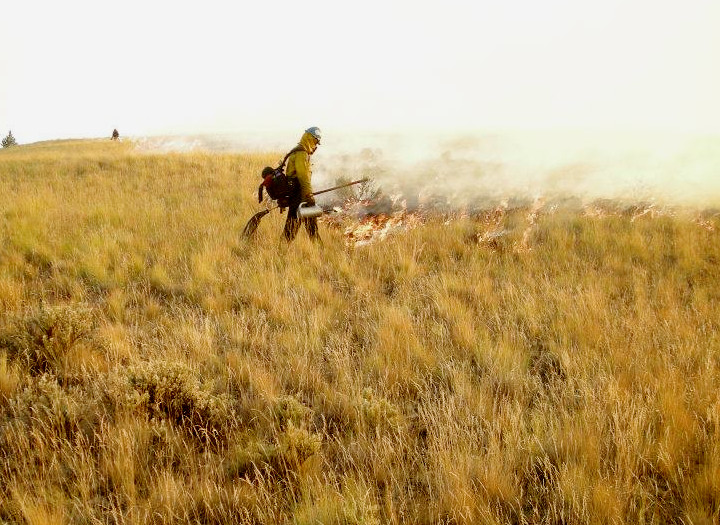
Dragonslayers Wildfire Hand Tools are ideal tools for management of fire-dependent ecosystems or when managing for multiple objectives such as protection of timber, rangeland improvement, hazardous fuels reduction, wildlife habitat improvement, or reintroduction of fire into fire-adapted ecosystems.

Dragonslayers tools are in use for prescribed burning by the Entiat IHC in Washington, by the Prineville IHC in Oregon and other IHCs throughout the western United States. Nonprofit conservation organizations have purchased tools to manage prescribed fire in critical wildlife habitat and fire-dependent ecosystems in California and Washington.

The tools are popular because of their ease of use, compact design, durability, and the because of the effectiveness of the Dragon Swatter in controlling prescribed fire in grassland and oak/grass and Ponderosa pine/grass ecosystems.

The durability and longevity of the tools are particularly attractive benefits for multi-year prescribed burn programs of long duration. Tools are backed by warranty and parts subject to heavy wear such as blades and handles can be replaced by Dragonslayers at a modest cost.  All Dragonslayers have a one-year warranty.  Program budgets can be more accurately predicted by program managers, knowing that the tools will last multiple years and not just the one or two years common to the conventional fire tools.

Titanium Core Felling Axe Head

Titanium Core Felling Axe Head

This was the original fire fighting felling axe developed by Dragonslayers.  The core plug is a lost wax casting made by the Ruger Firearms Company, made out of Titanium.  Too expensive to make and too difficult to machine it is no longer marketable, and will never again be produced.  These are now rare, unique and will soon be a very valuable collectors item; known only by fire history tool buffs.  We have only 60 left.

The BLM Bonneville Hot Shot Crew out of Salt Lake City created a better, Slam Hammer by welding a bar of steel to the Axe blade of our Magnum Pulaski.  That worked well for a while, but the Aluminum alloy could not withstand the battering force of driving felling wedges, and the blade began to loosen.  So they asked us to build them an all steel, slam hammer for driving felling wedges and having a grub-hoe blade.  So that is how the Dragonslayers Bonnie Hammer evolved.  A part of fire fighting history. that few know about.